[CVE-2020-1054] Win32k LPE Vulnerability Analysis
Table of Contents
0x00. Introduction
CVE-2020-1054 is an Elevation of Privilege (EoP) vulnerability in Win32k.sys, the Windows kernel graphics component. It was reported by Netanel Ben-Simon and Yoav Alon of Check Point Research, and bee13oy of Qihoo 360 Vulcan Team.
This post is based on 0xeb-bp’s analysis report and was written to enhance my own understanding of the vulnerability.
0x01. Root Cause Analysis
Crash Analysis
This vulnerability was identified by a PAGE_FAULT_IN_NONPAGED_AREA crash within the win32k!vStrWrite01 function. The code that triggered the crash is as follows:
int
The bugcheck result upon crashing is:
PAGE_FAULT_IN_NONPAGED_AREA (50)
Invalid system memory was referenced.  This cannot be protected by try-except.
Typically the address is just plain bad or it is pointing at freed memory.
Arguments:
Arg1: fffff904c7000240, memory referenced.
Arg2: 0000000000000000, value 0 = read operation, 1 = write operation.
Arg3: fffff960000a5482, If non-zero, the instruction address which referenced
    the bad memory address.
Arg4: 0000000000000005, (reserved)

Some register values may be zeroed or incorrect.
rax=fffff900c7000000 rbx=0000000000000000 rcx=fffff904c7000240
rdx=fffff90169dd8f80 rsi=0000000000000000 rdi=0000000000000000
rip=fffff960000a5482 rsp=fffff880028f3be0 rbp=0000000000000000
 r8=00000000000008f0  r9=fffff96000000000 r10=fffff880028f3c40
r11=000000000000000b r12=0000000000000000 r13=0000000000000000
r14=0000000000000000 r15=0000000000000000
iopl=0         nv up ei ng nz na po cy
win32k!vStrWrite01+0x36a:
fffff960`000d5482 418b36   mov esi,dword ptr [r14] ds:00000000`00000000=????????
The crash occurs because the memory address pointed to by the r14 register (0xfffff904`c7000240) is invalid. r14 is used as the destination address for a write operation. Let’s examine how this address is calculated and if it is controllable.
OOB Control
r14 is calculated using the instruction lea r14, [rcx + rax*4]. Tracking rcx and rax back, we can represent it in pseudo-code:
var_64h = 0x7fffffff;
var_6ch = 0x80000000;
while ( r11d )
{
    --r11d;
    if ( ebp >= var_6ch && ebp < var_6ch )
    {
        // oob read/write in here
    }
    ++ebp;
    ecx += eax;
}
Ultimately, the target address (oob_target) takes the form of a linear equation:
oob_target = initial_value + loop_iterations * eax
Through analysis, such as changing argument values during function calls, we can see that each variable is controlled as follows. However, it was noted that no matter how the values were changed, the lower 32 bits of oob_target were fixed at 0xc7000240, and only the upper 32 bits were controllable.
- loop_iterations: Determined by the 5th argument (
arg5) ofDrawIconEx.loop_iterations = ((1 - arg5) & 0xffffffff) // 0x30
- eax (increment): Determined by the 1st argument (
arg1) ofCreateCompatibleBitmap.lDelta = arg1 // 8- Acts as the offset to move to the next line in memory.
Now that where to write is determined, we need to check what to write—what values can be written and how much control we have over them. Examining vStrWrite01 closely reveals that write instructions are executed in the following two places:
// write 1
win32k!vStrWrite01+0x417
mov     dword ptr [r14],esi
// write 2
win32k!vStrWrite01+0x461
mov     dword ptr [r14],esi
The esi value undergoes an OR or AND operation with a certain value depending on conditions. Since OR operations are typically used in exploits to increase values or set specific bits, understanding the condition is crucial. The 8th argument of DrawIconEx, diFlags, stood out. Checking the official documentation revealed:
- If
DrawIconEx’s 8th argument (diFlags) isDI_IMAGE (0x6), an AND operation is performed. - If
DrawIconEx’s 8th argument (diFlags) isDI_MASK (0x1), an OR operation is performed.
As a result of the analysis, this OOB write vulnerability has unique constraints:
- Fixed Lower 32 bits: The upper 32 bits of the
oob_targetaddress can be controlled viaarg5, but the lower 32 bits are always fixed to a specific value like0xc7000240. This means the attacker cannot write to an arbitrary address but only to specific locations where the lower address matches. - Restricted Write (Bitwise Operation): Instead of overwriting with a desired value, an AND or OR operation is performed on the existing value.
0x02. Exploit
Due to the aforementioned constraints (fixed lower address, bitwise OR operation), conventional exploitation methods are difficult. However, remembering that even a 1-byte NULL overflow (House of Einherjar) allows for exploitation gives us hope. To overcome this, we utilize the SURFOBJ structure, a Windows kernel bitmap object.
typedef struct SURFOBJ64; // sizeof = 0x50
The fields critical for exploitation are:
pvScan0: Pointer to the actual bitmap data.sizlBitmap: Defines the width and height of the bitmap, consisting of two dwords.
Step 1. Heap Grooming
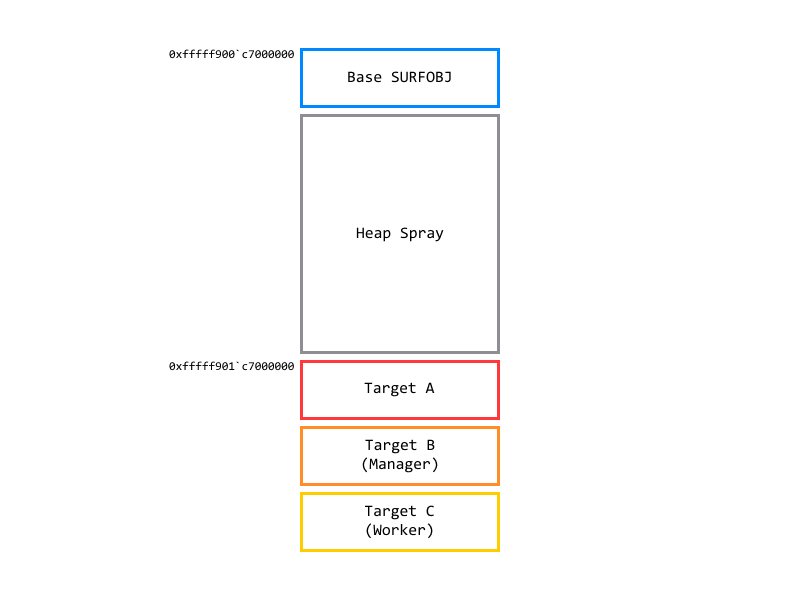
First, allocate a base SURFOBJ to be placed at 0xfffff900`c7000000. Then, repeatedly call CreateCompatibleBitmap to allocate multiple SURFOBJ structures and bitmap data in the kernel heap (Paged Pool).
The goal is to groom the heap so that one of them (Target A) is allocated exactly at 0xfffff901`c7000000.
Step 2. Target Selection & OOB Write
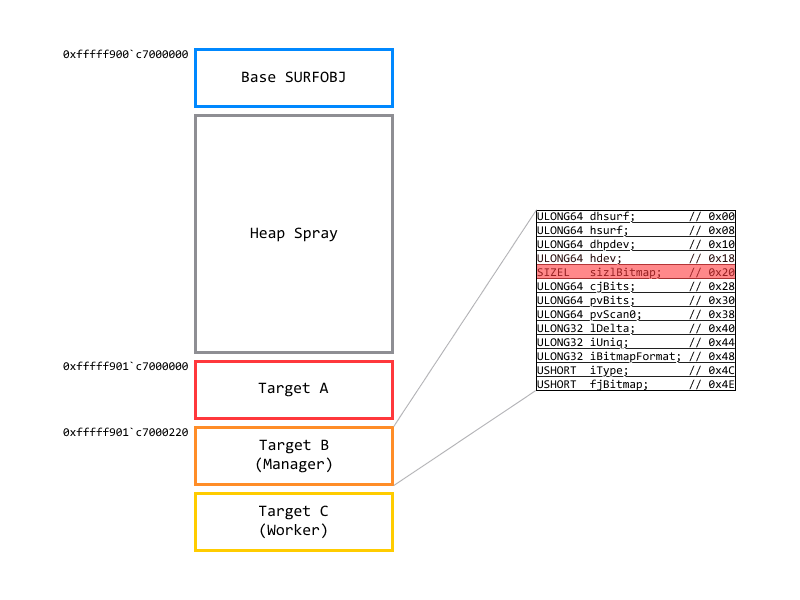
We are targeting the sizlBitmap field of Target B. This field defines the width/height of the bitmap. If this value becomes large, the kernel is tricked into thinking Target B is very large.
Matching Target B’s sizlBitmap field exactly with oob_target is tricky. If we don’t manipulate sizlBitmap precisely in a single write, a BSOD is likely to occur. Therefore, we need to carefully combine the arguments of DrawIconEx and CreateCompatibleBitmap. A brute force script was used to find this combination:
# start with size at 0x50000
= // 0x8
# lDelta is always byte alligned so ignore if not
= * 0x4 + 0x240
= + *
Step 3. Relative Read/Write
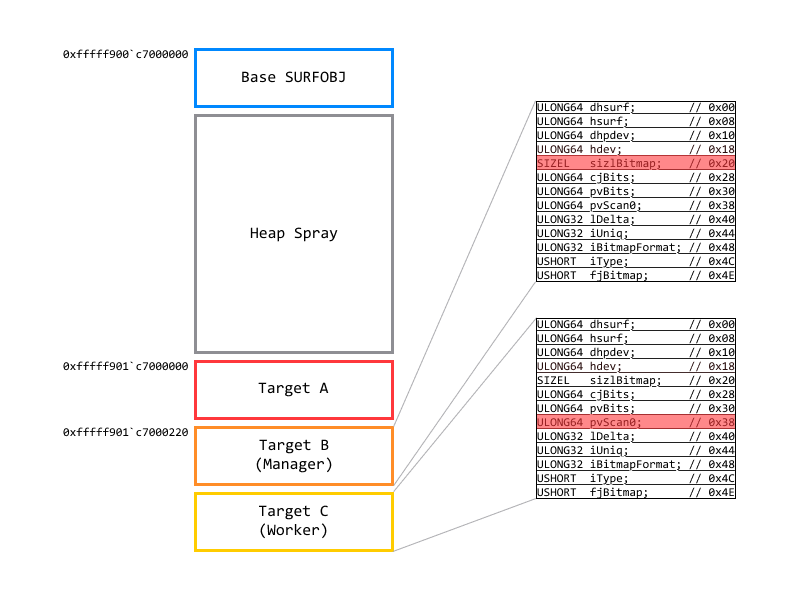
Now, Target B bitmap can access memory beyond its allocated region. Immediately following Target B, another bitmap structure, Target C, should be located.
Calling SetBitmapBits(Target B, ...) allows us to overwrite the pvScan0 field of Target C by overflowing from Target B’s data area.
Step 4. Arbitrary Read/Write
Now, full AAR/AAW is possible using the Target C bitmap.
- Set Where: Use Target B (Manager) to change Target C’s (Worker)
pvScan0to the desired address. - Do What: Call
GetBitmapBitsorSetBitmapBitsusing Target C (Worker) to read or write values of the kernel memory.
This completes the Arbitrary Read/Write Primitive.
Step 5. Token Stealing
With AAR/AAW secured, the rest follows standard techniques.
- Find the current process (
EPROCESS). - Find the System process (PID 4) (
EPROCESS). - Read the
Tokenvalue from the System process and overwrite the current process’sToken. - The current process now has System privileges.
0x03. Conclusion
This vulnerability stems from a combination of complex address calculation logic within the DrawIconEx graphics function and a lack of argument validation. It demonstrates a creative exploit technique that transforms a restricted OOB write (fixed lower address, bitwise operation) into a powerful AAR/AAW by manipulating SURFOBJ structures.
On Windows 7, structure offsets may vary depending on installed security updates (KB), so exploits must detect this dynamically or be adjusted for the specific version.